Business bank account fees explained: every charge on a UK tariff and what it means
Monthly fees, free periods, Faster Payments, Bacs, CHAPS, cash at the branch or the Post Office, cheques, international payments, card fees and unarranged borrowing - what each line on a UK business account tariff actually is, what the published tariffs charge for it, and a worked year for one small business on two different tariffs.
On this page
A UK business account tariff is a price list for twenty or so separate things, each with its own unit: per month, per item, per £100, per cent of value. No two banks group them the same way, and the headline monthly fee is often the smallest number on the page. This guide goes through every fee type you will meet, explains what each one is, shows what the published tariffs in our comparison charge for it, and then adds up a year for one hypothetical business on two tariffs. All figures are the providers’ own, read on 5 September 2026 from the documents under Sources, as our methodology requires. Tariffs change with notice; re-read the source before relying on a number.
Key facts
- Faster Payments “is available day and night, 365 days per year”; the system maximum is £1 million per payment and in 2025 it “processed 5.55 billion transactions with a value of £4.84 trillion” (Pay.UK).
- Bacs payments “typically fall into two categories: Direct Debit and Direct Credit”; in 2025 Bacs “facilitated 6.86 billion payments valued at £6.05 trillion” (Pay.UK).
- CHAPS “is a sterling same-day system” with “no minimum or maximum payment limit”, operated by the Bank of England (Bank of England).
- “At Post Office, we don’t charge deposit fees. But your bank may charge for cash deposits.” (Post Office)
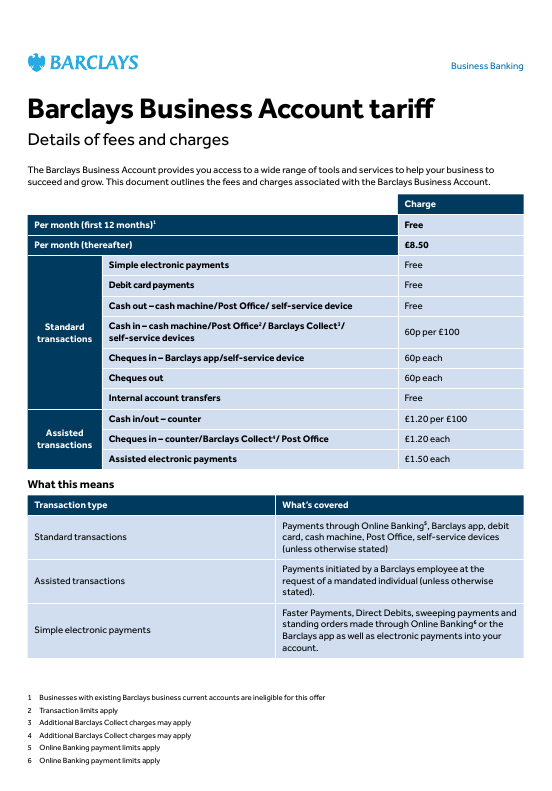
- Barclays’ tariff lists the Business Account at “Per month (first 12 months): Free; Per month (thereafter): £8.50”, with cash paid in at self-service devices or the Post Office at “60p per £100” (Barclays tariff).

The monthly fee and free periods
Most tariffs open with a fixed account maintenance fee. Among the standard small-business accounts in our comparison it runs from nothing to £25 a month. Barclays’ tariff lists “Per month (first 12 months): Free; Per month (thereafter): £8.50”. Lloyds’ Account Charges and Processing Times brochure lists a “General account maintenance fee £10.00 for each account”, and its product page offers “No account fee for 12 months if it’s your first Business Account with us”. HSBC’s Business Price List (dated 15 December 2025) charges no monthly fee on the Small Business Banking Account and £10.00 on the Business Banking Account. Some fees depend on the balance: Metro Bank charges £8 a month but waives it, with 30 free transactions, in any whole month the balance stays at £6,000 or above, and Allica’s Business Rewards Account charges “a £25 monthly fee” if the average balance in the previous month falls below £10,000.
Free periods are where the small print lives. Three things to read:
- What is free. NatWest’s charges leaflet says that during its free-banking period standard day-to-day charges do not apply; HSBC’s 12 months for Business Banking start-ups and switchers covers “all standard day-to-day current account transactions”. Barclays’ 12 months is stated on the monthly fee line of its tariff. Whether transaction charges are included matters a great deal if you handle cash.
- Who qualifies. NatWest: “You’ve started a business within the last 12 months with a projected or existing annual turnover that doesn’t exceed £1 million”. HSBC defines a start-up as “a customer within their first two years of trading that doesn’t already have a bank account with another bank”. Barclays: “Businesses with existing Barclays business current accounts are ineligible for this offer”.
- What ends it. NatWest, for accounts opened on or after 20 April 2026: “if your cash deposits into your account exceed £200,000 in any 12-month period, you’ll no longer qualify for free banking”.
Electronic payments: Faster Payments, Bacs and CHAPS
“Electronic payment” on a tariff covers three different UK systems, and knowing which one a line refers to explains the price.
Faster Payments is what a transfer from an app or online banking normally is. Pay.UK, which operates it, says the system “is available day and night, 365 days per year, supporting the demands of personal and business customers since its creation in 2008”. The system maximum is £1 million per payment, though individual banks set their own limits. In 2025 it “processed 5.55 billion transactions with a value of £4.84 trillion”. Barclays’ tariff says a Faster Payment reaches the recipient’s bank “Usually within 2 hours”.
Bacs is the older batch system. Pay.UK describes it as “an electronic transfer service used to make payments between accounts” whose payments “typically fall into two categories: Direct Debit and Direct Credit”. Bacs Direct Credit is the rail behind most payroll: Bacs’s own page calls it “a simple, secure and reliable way to make and receive payments by electronic transfer directly into a payment service provider account”, used for “wages and salary payments” and for “pensions, employee expenses, insurance settlements, dividends and refunds”. It is not instant: Barclays’ tariff notes that a Direct Debit originator will “submit the request at least three working days before the payment date”. In 2025 Bacs “facilitated 6.86 billion payments valued at £6.05 trillion”.
CHAPS is the Bank of England’s high-value system. Its page states: “CHAPS is a sterling same-day system that is used to settle high-value wholesale payments as well as time-critical, lower-value payments like buying or paying a deposit on a property.” There is “no minimum or maximum payment limit”, and the system is “usually open from 6am to 6pm, Monday to Friday”. Banks charge for it: Barclays £15 online or £25 in branch or by phone; Lloyds £30; Virgin Money M Account £17.50 online or £25 in branch; Metro Bank and Allica £25 and £20.
Tariffs price the everyday electronic payments in three ways:
- Per item. NatWest: “Automated payments (in or out) £0.35 per item”, covering Direct Debits, standing orders, automated credits and internet Faster Payments. Metro Bank: £0.30 per UK transaction, including inward payments, unless the balance waiver applies.
- Free up to a cap. Zempler: “3 free a month (35p after)” on Business Go, 20 on Business Extra and 500 on Business Pro, with receiving “Free & unlimited”. Allica: “Faster Payments are free for up to 150 transactions per month, after which a £0.12 fee applies per payment.”
- Free. Barclays: “Simple electronic payments” are free, “Assisted electronic payments” £1.50 each. Lloyds: Faster Payment debits and credits, Direct Debits and standing orders are “Included at no extra cost”. Starling: “No fees on UK payments, in or out”. Monzo: “Sending money within the UK: £0”.
Note that on NatWest’s tariff automated credits are £0.35 each, and ANNA’s Free plan takes “0.95% commission” on incoming payments above £1,000 in a month.
Cash deposits: branch, machine and Post Office
Cash is the most expensive thing a business account does, and it is priced by value, by item, or both.
Per £100 of value. Barclays: “60p per £100” at a cash machine, Post Office, Barclays Collect or self-service device, and “£1.20 per £100” over an assisted counter. Lloyds: “£1.60 for every £100” at a branch counter, cash machine, depositpoint, Nightsafe or Post Office, plus an £0.85 charge per credit paid in; “£0.85 for every £100” through an Immediate Deposit Machine. NatWest: “£0.95 per £100, plus a manual payment charge of £0.95 per item”. Virgin Money M Account: “£0.90 per £100” plus a “Manual Credit £0.95 per credit”. The Co-operative Bank Business Bank Account: “£1.50 per £100”.
Percentage of value. HSBC: a “Branch credit” of £1.50 per credit plus “Cash in” at 1.50% of the value, the same at the Post Office. Metro Bank: 1.00% in store. Starling, through the Post Office: “0.7% fee (minimum £3 fee)”. Zempler, through the Post Office: “£4 minimum fee or 0.55% fee will apply to the total amount deposited”.
Flat per deposit. Monzo: “£1 per deposit to pay in cash at any PayPoint or Post Office”. Mettle: “£2.75 per deposit” through the Post Office.
Free allowances. Santander: “you can pay in up to £1,000 in cash at Santander cash machines without charge” in each billing month, then £1.25 per £100.
Branch versus Post Office. Every bank in our comparison that publishes a cash tariff also appears on the Post Office’s everyday banking list of banks whose customers can use its counters. The Post Office is clear about who sets the price: “At Post Office, we don’t charge deposit fees. But your bank may charge for cash deposits.” And: “Your bank decides which services you can use there, along with any limits or charges.” Its business banking guide adds a physical limit of its own: “If it has an open plan counter, you can deposit up to £4,000. If the counter has a glass screen, the limit is £20,000.” So whether the Post Office costs the same as a branch depends on the bank: Barclays prices it at its self-service rate (60p per £100), HSBC at its branch rate (£1.50 plus 1.50%), Lloyds at its counter rate (£1.60 per £100), and the Co-operative Bank’s Directplus adds “80p per credit” for Post Office deposits.
Cheques
Cheques are priced per item and, increasingly, by channel. Barclays: 60p each through the app or a self-service device, £1.20 each over a counter, at Barclays Collect or the Post Office; cheques you write cost 60p each. Lloyds: £0.85 via the app or an Immediate Deposit Machine, £1.20 at a counter, and £1.20 for each cheque paid out. NatWest: “£0.75 per item” via the app; at a branch or Post Office £0.95 per cheque plus a £0.95 manual charge, and its leaflet gives the example “three cheques = £3.80”. HSBC: 50p per cheque by mobile deposit, or a £1.50 branch credit plus 50p per cheque. Starling: “free, via freepost or in the app”. Zempler does not take cheques at all. Stopping a cheque is a separate charge: £10 at Lloyds and HSBC, £5 at the Co-operative Bank.
International payments and currency conversion
International charges come in three layers: a fee per payment, a currency conversion charge built into the exchange rate, and other banks’ charges along the way. Barclays’ tariff shows all three. A SEPA euro transfer costs £0.35 in the app; a Barclays International Payment costs £15 in the app or £25 assisted; and “If we need to convert the payment into another currency, we’ll use our latest Barclays Reference Exchange Rate and will apply a currency conversion charge. The conversion charge we apply will be no more than 2% for business customers.” HSBC charges £17.00 by Business Internet Banking and 24p by SEPA Credit Transfer. Receiving is charged too: Barclays £6 for an international payment over £100; Lloyds £2 up to £100 and £7 over. The subject has its own guide: Multi-currency business accounts and FX fees.
Card fees
A debit card comes with every account in the comparison, and spending in sterling in the UK is free on all of them, except that Metro Bank counts card payments among its £0.30 transactions unless the balance waiver applies. The charge to watch is the non-sterling transaction fee, applied when you pay in a foreign currency or abroad: 2.75% at Barclays, Lloyds, NatWest and the Co-operative Bank; 2.75% (minimum £1.50) at Virgin Money, with 3.75% (minimum £1.50) on cash withdrawals; 2.99% at Metro Bank outside its listed European countries and on Zempler’s Business Go; 2.75% on Tide’s Free plan and 0% on its paid plans; £0 at Monzo; “no fees from us” at Starling.
Overdrafts and unarranged borrowing
An arranged overdraft is a separate credit agreement with its own interest rate and, often, a fee. Santander publishes a representative 14.94% EAR (variable) on arranged overdrafts of £500 to £25,000 with an annual fee of 1.75% of the limit, minimum £100.
Unarranged borrowing - going overdrawn without agreement, or beyond an agreed limit - is priced separately and usually higher. Barclays: unarranged overdraft interest 29.5% per annum. Metro Bank: 25% EAR. NatWest: interest at 15% per annum plus a “paid referral fee £20” and an “unpaid item fee £12”. Santander: 14.94% EAR with no paid or unpaid item fee. Lending is outside the scope of our comparison table; these figures are here so the fee types are visible, not to rank providers.
A worked example: one business, two tariffs
Take a hypothetical small limited company: a shop with a modest cash trade. Each month it makes 40 outgoing electronic payments (suppliers, Direct Debits, wages by Faster Payments), pays in £2,000 in cash across four deposits at the Post Office, and pays in four cheques through the app. No international payments, no overdraft. It is outside any free period, so the standard tariff applies.
Tariff A: Barclays Business Account (tariff PDF UK_0324, read 5 September 2026)
- Monthly fee: £8.50 x 12 = £102.00
- Electronic payments: “Simple electronic payments” are free = £0.00
- Cash: £2,000 a month at 60p per £100 (Post Office rate) = 20 x £0.60 = £12.00 a month; x 12 = £144.00
- Cheques via the app: 4 x £0.60 = £2.40 a month; x 12 = £28.80
- Year: £102.00 + £0.00 + £144.00 + £28.80 = £274.80
Tariff B: NatWest Business Current Account (Standard Charges leaflet correct as at 20 April 2026, read 5 September 2026)
- Monthly fee: “no monthly charge” = £0.00
- Electronic payments: 40 x £0.35 = £14.00 a month; x 12 = £168.00
- Cash: £2,000 at £0.95 per £100 = 20 x £0.95 = £19.00, plus 4 deposits x £0.95 manual payment charge = £3.80; £22.80 a month; x 12 = £273.60
- Cheques via the app: 4 x £0.75 = £3.00 a month; x 12 = £36.00
- Year: £0.00 + £168.00 + £273.60 + £36.00 = £477.60
Now change one assumption. If the same business took no cash at all, Tariff A falls to £102.00 + £28.80 = £130.80 and Tariff B to £168.00 + £36.00 = £204.00. The ordering depends on the mix of transactions, not on the monthly fee, which is why our comparison shows the per-item and per-£100 lines rather than a single headline.
Two cautions. First, these are standard tariffs; during a free period the picture is different, since NatWest’s two years of free banking on day-to-day charges would remove most of Tariff B for a qualifying start-up or switcher, while Barclays’ 12-month offer is stated against the monthly fee. Second, both banks change their tariffs with notice, so re-read the source PDFs under Sources before using the figures.
How the money in the account is protected is a separate question from what the account costs: see FSCS protection vs e-money safeguarding.
Sources
Primary sources only: the provider, the regulator or the official body. Links open in a new tab.
- Pay.UK - Faster Payment System · accessed 2026-09-05
- Pay.UK - Bacs Payment System · accessed 2026-09-05
- Bacs - Bacs Direct Credit · accessed 2026-09-05
- Bank of England - CHAPS · accessed 2026-09-05
- Post Office - Everyday banking (services by bank) · accessed 2026-09-05
- Post Office - Where to pay in your business takings · accessed 2026-09-05
- Post Office - Business banking guide · accessed 2026-09-05
- Barclays - Business Account tariff (PDF, UK_0324) · accessed 2026-09-05
- HSBC UK - Business Price List (PDF, 15 December 2025) · accessed 2026-09-05
- Lloyds Bank - Account Charges and Processing Times (PDF) · accessed 2026-09-05
- Lloyds Bank - Business accounts for start-ups and small businesses · accessed 2026-09-05
- NatWest - Business account charges (PDF, correct as at 20 April 2026) · accessed 2026-09-05
- Santander - Business Current Account Classic Key Facts Document (PDF) · accessed 2026-09-05
- Metro Bank - Business Bank Account Important Information Summary (PDF) · accessed 2026-09-05
- The Co-operative Bank - Business Bank Account tariff (PDF) · accessed 2026-09-05
- The Co-operative Bank - Business Directplus tariff (PDF) · accessed 2026-09-05
- The Co-operative Bank - FSB account tariff (PDF) · accessed 2026-09-05
- Virgin Money - M Account for Business tariff guide (PDF) · accessed 2026-09-05
- Virgin Money - Business Banking tariff guide (PDF) · accessed 2026-09-05
- Starling Bank - Business account · accessed 2026-09-05
- Monzo - Business account fee information · accessed 2026-09-05
- Tide - Pricing · accessed 2026-09-05
- Zempler Bank - Business current account pricing · accessed 2026-09-05
- Mettle - Fee information document · accessed 2026-09-05
- Allica Bank - Business Rewards Account fees and limits · accessed 2026-09-05
- ANNA Money - Pricing · accessed 2026-09-05
Bank Solutions publishes information built from providers' published terms. It is not financial advice and does not take your circumstances into account. Corrections: editor@banksolutions.uk.