Press release · 30 September 2026 · Protection
Nine UK business accounts rely on safeguarding rather than the FSCS £120,000 guarantee
ANNA Money and Wise Business say business funds are not FSCS-protected, and for Tide it depends on which account a customer holds
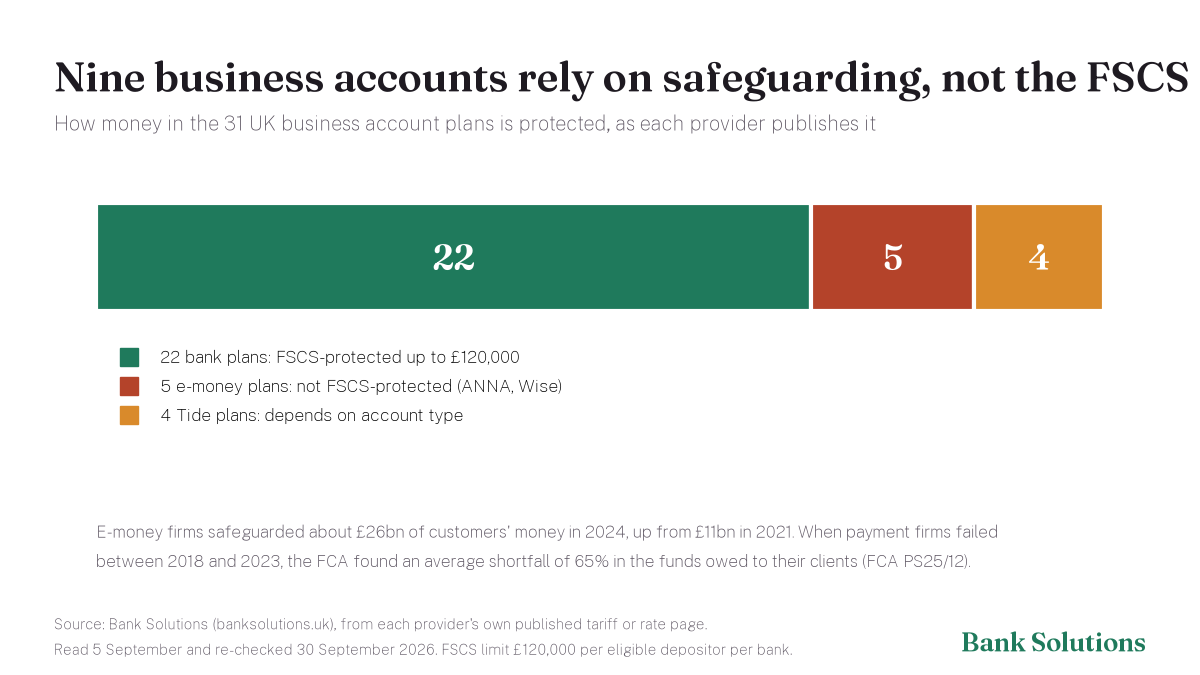
Nine of the 31 UK business current account plans compared by Bank Solutions are e-money products, where a business relies on its provider safeguarding its money rather than on the Financial Services Compensation Scheme (FSCS).
The other 22 plans, from 13 banks, all publish FSCS protection, which covers eligible deposits up to £120,000 per depositor at each bank. The limit rose from £85,000 on 1 December 2025.
Which accounts
ANNA Money's four plans and Wise Business publish that customers' funds are not protected by the FSCS. For Tide's four plans, it depends on the account: Tide's ClearBank-powered accounts are FSCS-protected, while its older PrePay Technologies e-money accounts are safeguarded instead. Tide describes itself as "not a bank".
Why it matters
Safeguarding means an e-money firm must keep customers' money separate from its own. It is not a guarantee of repayment. E-money institutions safeguarded around £26bn of customers' money in 2024, up from £11bn in 2021. For payments firms that became insolvent between the start of 2018 and mid-2023, the Financial Conduct Authority found an average shortfall of 65% in the funds owed to their clients (FCA policy statement PS25/12).
The FCA's supplementary safeguarding regime came into force on 7 May 2026. It requires reconciliations at least once each reconciliation day, a monthly safeguarding return to the FCA, an annual safeguarding audit for firms above a £100,000 threshold, and a resolution pack for use if a firm fails.
The small print on the banks, too
Twenty of the 31 plans state the £120,000 figure in their own protection wording; Barclays, HSBC, Lloyds, NatWest and Starling link to an FSCS information sheet without stating it. The FSCS treats a limited company as a separate depositor from its director, but a sole trader's business and personal accounts at the same bank share a single £120,000 limit.
Sam Allcock, editor of Bank Solutions, said: "Safeguarding and the FSCS are different things, and most business owners never find out which one their account relies on until something goes wrong. E-money accounts are useful and often cheaper, but a business keeping its VAT or payroll money in one should know what protects it."
The full report, with each provider's protection wording and the regulators' own descriptions of both regimes, is at banksolutions.uk/reports/fscs-or-safeguarded-2026.
Notes to editors
- Dates. Every tariff was read from the provider's own published document on 5 September 2026 and re-checked on 30 September 2026, when none of the 31 plans had changed.
- Sources. Each provider's published protection wording; the FSCS on the £120,000 limit; the FCA's policy statement PS25/12 on safeguarding and the supplementary regime from 7 May 2026. Figures on safeguarded funds and insolvency shortfalls are the FCA's.
- Coverage. 31 plans from 16 providers open to new business customers in the UK. Revolut Business is not included because its pricing pages could not be read.
- Credit. Source: Bank Solutions analysis of providers' published tariffs (banksolutions.uk). Online, please link to the page the figure came from.
- About Bank Solutions. An independent UK business banking comparison published by Domain Farm Ltd (company number 13544286). No bank or provider pays for or sees a figure before publication. Bank Solutions earns referral fees from some providers, which never affect a figure or a ranking.
- Contact: Sam Allcock, editor, editor@banksolutions.uk
Today's figures: the full report